
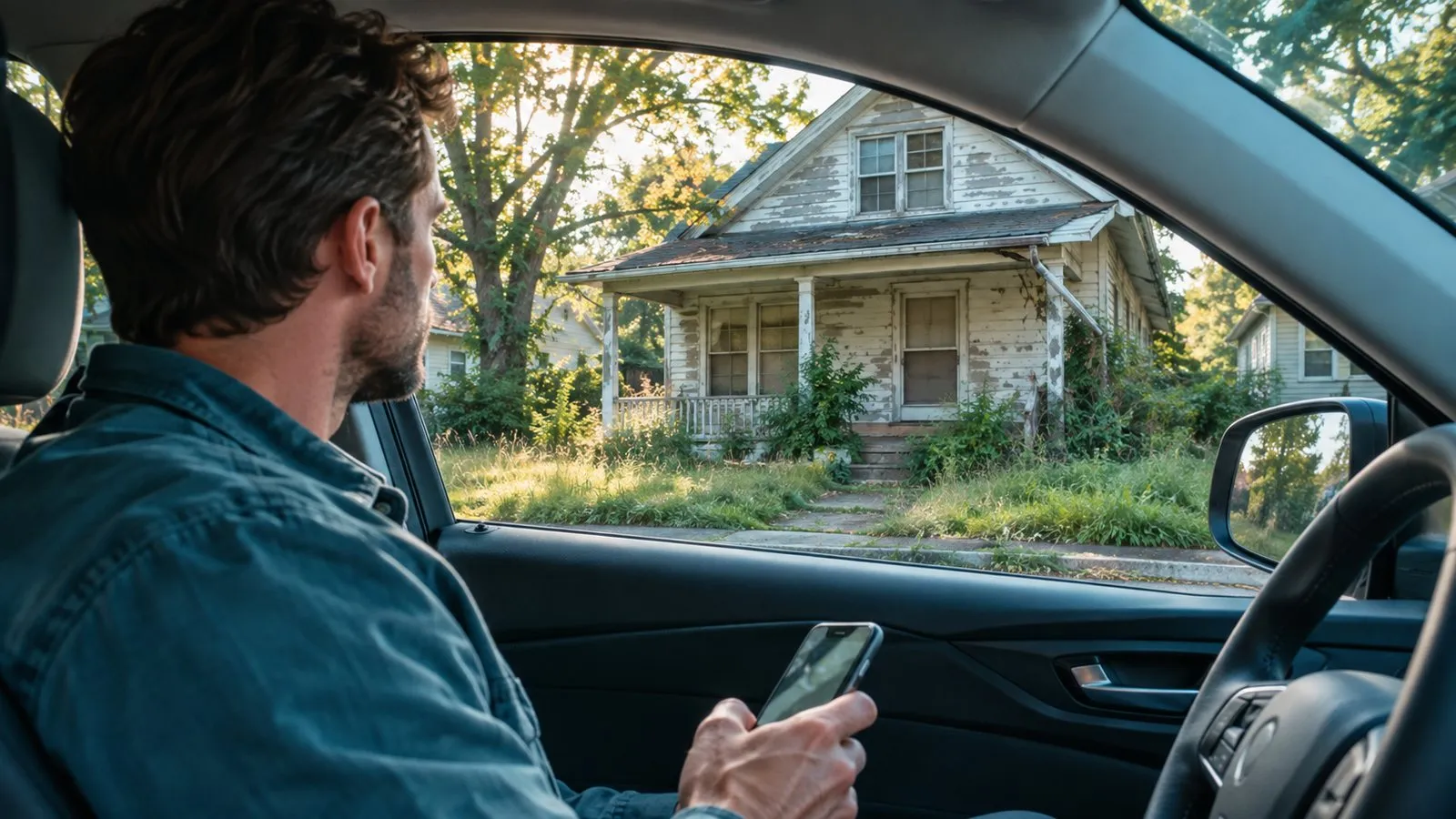
Driving for dollars means driving (or walking, or biking) through neighborhoods, writing down houses that look neglected or empty, finding who owns them, and asking the owner if they would sell. It costs almost nothing to start and it works, but it costs a lot of hours per deal.
Most guides stop at the checklist: look for tall grass, log the address, send a postcard. This one covers that, then answers the questions people keep asking in YouTube comments and on Reddit that the ranking guides skip: how many houses it really takes to get one deal, what to do when the owner is an LLC or the yard has a no trespassing sign, whether virtual driving is good enough, whether you can text these owners legally, and what a driving for dollars deal costs once you put a price on your time. We close with where it fits next to buying leads, using our own numbers from a little over $15 million in ad spend and roughly $51 million in client revenue.
What driving for dollars is, and what it is not
You are building your own list of possibly motivated sellers by looking at the properties themselves. The idea is simple: a house that shows neglect often has an owner with a reason to sell, such as an inheritance nobody wants to manage, a tired landlord, a repair bill they cannot afford, or a move that already happened.
Two things it is not. It is not a list of sellers. A rough house tells you about the house, not the owner, and plenty of owners of ugly houses have no plans to sell. And it is not free. The cash cost is low, but the hours are real, and we put numbers on both further down.
Wholesalers, flippers and buy and hold investors all use it. Some agents do too, when a buyer client cannot find anything listed that fits.
What to look for while you drive
The ranking guides agree on the core signals. Group them into three buckets so you score houses the same way every time.
Physical distress
- Roof with missing shingles, a tarp, or clearly older than its neighbors
- Peeling paint, damaged or missing siding, rotted trim
- Broken, boarded or covered windows (sheets hung as curtains are a common tell)
- Gutters hanging loose or missing downspouts
- Cracked foundation, broken steps, damaged ramps or railings
Vacancy
- Tall grass, weeds, overgrown shrubs
- Mail or flyers piling up, utility notices or code notices taped to the door
- No car for weeks, no lights at night, water shutoff tags
- Boarded doors or a lockbox with no listing
Owner situation
- The one dated house on a block that has been flipped around it
- An older owner and a property that has slowly fallen behind on maintenance
- A for sale by owner sign, or an estate sale sign with an attorney’s number
- Code violation stickers or a condemned notice
Score it, then check the location
Give each house a 1 to 5 condition score (1 is a teardown, 5 is fine). New investors do best on 2s and 3s: dated, tired, cosmetic to moderate work. A boarded house on a busy commercial road can look like a great deal and still be a poor one, because the buyers you will sell to care about the street as much as the house. Note traffic, neighbors and anything commercial next door.
How to drive for dollars, step by step
- Pick a farm area. A few square miles of older housing (built before roughly 1980) where houses actually trade. Check recent sales on any listing site to confirm investors are buying there.
- Plan the route. Mark the streets you will cover so you never drive the same block twice in a month. A printed map you highlight works; so does the route tracking in a driving app.
- Drive slowly, log fast. Capture the address, a photo, the condition score and the signals you saw. Two people works best: one drives, one logs.
- Find the owner. Look up the parcel on the county assessor or tax site to get the owner of record and mailing address. A mailing address in another state means an absentee owner, which is a strong signal on its own.
- Skip trace for phone and email. Run the owner through a skip tracing service. Expect some numbers to be dead.
- Reach out on more than one channel. Mail to the owner’s mailing address (not just the property), call, and text where it is legal (see the texting section).
- Follow up on a schedule. Most owners will not be ready the first time. The cadence below is where most of the deals come from.
- Analyze and offer. Get a real after repair value, estimate repairs, and make an offer that works for your exit.
- Get it under contract and close. Open title with an investor friendly title company, then close yourself or assign the contract to a cash buyer. That closing is the point of every step above it.
Driving for dollars apps and what they cost
You do not need an app to start. A notes app, a spreadsheet and your county assessor website will get you to your first deal. Apps save time by combining the steps: tap a house, pull the owner, skip trace, add to a mail campaign.
| Tool | What it does well | Watch for |
|---|---|---|
| DealMachine | Tap a house to pull owner data, built in skip tracing and postcards, route tracking | Plans start at $99 a month on its pricing page; postcards were listed at $0.70 to $0.89 each when we checked on October 22, 2026 |
| PropStream | Large property database, list filters (absentee, equity, vacancy), comps | Better for list building than for logging on the street |
| Invelo | AI scoring of distress from imagery, so you can screen an area from a desk | Imagery based, so it inherits the image age problem below |
| Zillow favorites | Free. Save houses from your current location as you walk or drive | No owner data, you still need the assessor and a skip trace |
| County assessor site plus spreadsheet | Free, official owner of record and mailing address | Slow, one parcel at a time |
App store reviews of driving for dollars apps split hard between people who love them and people who say they wasted money. The pattern in the complaints is usually the same: the app was paid for months before the user had a follow up system. Buy the tool after you have a process for working what it finds.
How many houses do you need to drive past to get one deal?
This is the most asked question in the comments under the popular driving for dollars videos, and the numbers people quote are far apart. One well known coach tells beginners to find 100 houses, have 50 conversations, make 20 to 25 offers and expect one contract. A viewer replied that another YouTuber says it takes 300 houses per deal. Both can be true. The difference is almost entirely your contact rate.
Here is the funnel, with each step stated so you can plug in your own numbers. These are example figures, not measured results.
| Step | Optimistic | Middle | Conservative |
|---|---|---|---|
| Houses logged | 100 | 200 | 300 |
| Skip trace finds a working number (assume 70%) | 70 | 140 | 210 |
| Owners you actually talk to, over several attempts | 50 (71%) | 50 (36%) | 42 (20%) |
| Offers made | 20 to 25 | 20 to 25 | 20 |
| Contracts | 1 | 1 | 1 |
The 100 house version assumes you reach half of every house you log. That only happens when you also door knock and keep calling for weeks. If you reach about a third of the owners you have numbers for, you need about 200 houses per contract. If you reach one in five, you are near 300. So the question to ask yourself is not how many houses, it is how many owners you will actually get on the phone or on the porch.
Practical target: 50 real conversations with owners per contract, and 20 or more offers. Track conversations, not addresses.
How many properties can you log in an hour?
It depends entirely on the neighborhood. In a recent Reddit thread, one wholesaler said he logged 60 vacant or very distressed homes in about an hour a day for seven days in a distressed part of Gastonia, North Carolina, and had two under contract by the end of the week. Another said you can hit 100 or more an hour in parts of Milwaukee. Someone riding an e bike through a neighborhood got 20 in 45 minutes. In a stable suburb you might log five.
Use your first two sessions to measure your own rate. If you are logging fewer than 15 an hour, you are in the wrong area, not doing it wrong.
Is virtual driving for dollars good enough for a beginner with no money?
Virtual driving means scrolling Street View or using an imagery tool instead of a car. It is free, and it is how a lot of people start. The problem every experienced commenter raises is image age. Street View photos can be one to six years old, so you will log houses that have since been bought and rehabbed and miss houses that fell apart last year.
If you do it virtually, do three things:
- Check the capture date. Street View shows the month and year the image was taken. Skip anything older than about two years, or confirm it with a quick drive by.
- Use your city’s 311 or code enforcement data. Many cities publish service requests and violations (high grass, open structure, junk vehicles). Those are current and point straight at neglected properties.
- Treat a rehabbed house as a win. If the distressed house in the old photo now looks brand new, someone bought and fixed it. Look up who. That is a cash buyer working your area, and you want them on your buyers list.
Our view: virtual is fine for picking which neighborhoods to drive. In person is better for the actual list, because you see what is true today.
What if the owner is an LLC, a trust or an estate?
Skip tracing an LLC name returns nothing useful, because a company has no personal phone number. Work it in two steps.
- Find the people behind the entity. Search the LLC name on the Secretary of State business search for the state where it is registered. Annual reports often list a manager, member or organizer. The registered agent is frequently a paid service company, so do not stop there.
- Skip trace the person, not the company. Once you have a manager’s name and city, run that person.
- Mail the entity anyway. Send a letter to the mailing address on the tax bill. Landlords who own through an LLC do read their mail.
For a trust, the trustee is the decision maker; the name is often on the deed. For an owner who has died, the property may be in probate, and the personal representative on the court file is the person to contact. Our guide to probate leads covers how to find and approach them respectfully.
The house has a no trespassing sign. What now?
Do not walk onto the property to knock. Note the sign in your log and work the owner through the mail, phone and text instead. You lose nothing, because a door knock was only ever one channel.
A no trespassing sign on a vacant house also tells you something: the owner is aware of the property and is trying to protect it, which often means they live elsewhere. That is an absentee owner, which is one of the better signals on your list. Look up the mailing address on the tax record and lead with mail.
Handwritten letters, fake names and texting: what is allowed?
Why do people say the letter should look handwritten?
Because the first job of the letter is to get opened and read. A handwritten or handwritten style note looks personal and gets past the glance that sends printed marketing to the recycling bin. That is practitioner experience, not a law of nature, so test it against a plain printed letter on your own list.
Can I use a fake name on the letter?
No. You are asking someone to sell you their home. The purchase agreement will carry your real name or your company’s name, the title company will verify who you are, and a seller who finds out you lied in your first contact will not sign. Use your real first name, or your properly registered business name.
Can I text the owners I find?
Be careful here. The FCC treats text messages as calls under the Telephone Consumer Protection Act, the National Do Not Call Registry covers texts, and mass texting from software is where investors get sued. Business texting through most providers also requires 10DLC carrier registration, which is why bulk texting from a regular business line stopped working for many people. Hand typed, one to one texts to numbers you have scrubbed against the Do Not Call list carry far less risk than blasts, but the rules vary by state and change. Get advice from a lawyer who handles TCPA before you text at any volume.
How do you know what the house is worth?
A Zestimate is a starting point, not a value. It assumes a house in typical condition, which a driving for dollars house is not. Pull real sold comparables: similar size, same neighborhood, sold in the last six months.
In non disclosure states (Texas, Utah and Kansas are among them) sale prices are not in the public record, so free sites often show a list price or nothing. Your options are an agent with MLS access, a paid data tool, or asking local investors and title companies what things are trading for.
Then sanity check the offer with the 70 percent rule many flippers use: maximum offer is about 70 percent of after repair value minus repairs. On a house worth $200,000 fixed up that needs $40,000 of work, that is $200,000 x 0.70 minus $40,000 = $100,000. If you are wholesaling, your assignment fee comes out of the room between your contract price and that number.
Some houses are worth more as land than as a house, especially the one dated house on a block of new builds. Check what vacant lots sell for nearby before you price it as a rehab.
Do you need your own money to make this work?
Less than people think, but not zero. If you wholesale, you put the house under contract and assign the contract to a cash buyer, who brings the purchase money. You usually put up an earnest money deposit with the title company. The amount is negotiable and set in the contract, so agree to an amount you can afford to lose if you fail to perform.
Two cautions. First, several states now regulate wholesaling (Illinois and Oklahoma are among them), so read your state’s rules before you assign a contract. Second, the hard part is rarely the money. It is having a buyer ready, which is why the next section matters.
If you want to buy and hold with a mortgage instead, say so in your letter. Owners respond to honesty, and a straightforward “I want to buy your house to live in or rent out” letter is a different and legitimate offer.
Does driving for dollars work in a small town?
Yes, but run the math before you commit. A common rule of thumb is a market of 100,000 people or more, mostly because a bigger market has more houses and more cash buyers. In a town of 28,000 you can still do it; you just run out of streets faster.
Count it: if your town has about 300 houses worth logging and you need roughly 200 logged houses per contract (the middle scenario above), your whole town is worth one or two contracts per pass. That is fine as a side income. To build a business, widen the farm to the county and the towns around it, and drive each area again every few months.
Use the same drive to build your buyers list
Bird dogs and new wholesalers ask how to find more cash buyers when every buyer has a different buy box. Your drive already shows you.
- Dumpsters, contractor trucks and permits on a house mean someone is rehabbing. Look up the owner. It is often an LLC that buys in that area.
- Freshly flipped houses on a rough block tell you a buyer is already active there. Pull the deed for their purchase price.
- Write down the buy box from the evidence. Price range, house size, neighborhood. That is better than asking a buyer to describe it.
This also answers the question about whether investors buy in rough areas. Some do and some do not. The rehabbed houses on the street tell you which, before you spend a dollar on marketing.
A follow up cadence that matches how sellers decide
Most of your list is not ready to sell this week. The investors who get deals from driving for dollars are the ones still in touch when the owner’s situation changes. This is the cadence we suggest; it is a recommendation, not a measured result.
| When | Touch |
|---|---|
| Day 1 | Letter to the tax mailing address; note on the door if you visited and it is safe and allowed |
| Days 2 to 7 | Call each skip traced number twice at different times of day; leave one short voicemail |
| Week 2 | Second letter or postcard with a different angle (as is, no repairs, you pick the closing date) |
| Weeks 3 to 8 | One call or legal one to one text every two weeks |
| Month 3 onward | Postcard every month or two; drive by again to see if anything changed |
| Any change | New code notice, a listing that expired, a death or divorce filing: move them to the top and call |
Track every touch. If you do not have a CRM, a spreadsheet with a next contact date column is enough. For inbound leads we run a separate, much faster sequence because those sellers asked to be contacted; it is published as our 7 day lead sequence.
What a driving for dollars deal really costs
Nobody prices this out, so here it is. The figures below are example math using the middle scenario (200 houses logged per contract) and stated assumptions. Swap in your own.
| Item | Assumption | Per contract |
|---|---|---|
| Driving and logging | 200 houses at about 30 an hour, plus planning | About 7 hours |
| Mileage | 100 miles at $0.70 a mile (the IRS 2025 business rate) | $70 |
| Skip tracing | 200 records at an assumed $0.20 each | $40 |
| 2 postcards to each owner at $0.75 | $300 | |
| Calls and texts | About 4 dial or text attempts per house at about 1 minute each | About 13 hours |
| Conversations | 50 conversations at about 15 minutes | About 12 hours |
| Analysis and offers | 20 offers at about 15 minutes | About 5 hours |
| Total per contract | About $410 and 37 hours |
Most investors close about half the contracts they sign, so double it for a closed deal: about $820 in cash and 74 hours. Now put a price on your hours:
| Your time is worth | Cost per closed deal |
|---|---|
| $0 an hour | $820 |
| $25 an hour | $2,670 |
| $50 an hour | $4,520 |
| $100 an hour | $8,220 |
Driving for dollars is cheap in cash and expensive in time, and it does not scale past the hours you personally have. Most of those hours are follow up, not driving. That is the part to systemize or hand off first.
Where driving for dollars fits next to buying leads
We sell inbound seller leads, so weigh this accordingly, but these numbers are ours and we have published them before. On the data our clients report back to us, a $100 statewide inbound lead converts to a contract about 1 in 17 times, which is $1,700 per contract and about $3,400 per closed deal at a 50 percent close rate. A $75 cold call lead converts about 1 in 50, which works out to about $7,500 per deal. The full breakdown is in inbound vs cold call leads: the real cost per deal.
Put that next to the table above and the decision gets simple:
- If your time is worth less than about $35 an hour (you are starting out, have more time than cash, or want to learn a market street by street), driving for dollars beats buying leads on cost per deal. Do it.
- If your time is worth more than that, or you need more than a deal or two a month, buying inbound leads is cheaper per closed deal and the hours go to sellers who asked to hear from you. Inbound still takes phone time, but it is 17 conversations per contract instead of 200 houses.
- Most operators end up doing both. Inbound for steady volume, driving for dollars in one or two target neighborhoods where you want to be the buyer everyone knows, and to keep your buyers list current.
If you are comparing sources, our ranking of 7 ways to find distressed properties by cost per deal and the guide to finding off market properties go wider. If you want to see whether exclusive inbound leads are available in your area, check motivated seller leads by market.
Frequently asked questions
Is driving for dollars worth it?
How many houses do I need to find to get one deal?
How much is DealMachine a month?
Is driving for dollars legal?
How do I find the owner of a house I found driving for dollars?
Does virtual driving for dollars work?
What is the 70 percent rule?
How long should I keep following up with a driving for dollars lead?
Want leads like this?
We send exclusive, ready-to-close leads straight to you. See if your area is open.
More on this topic: Lead Generation